



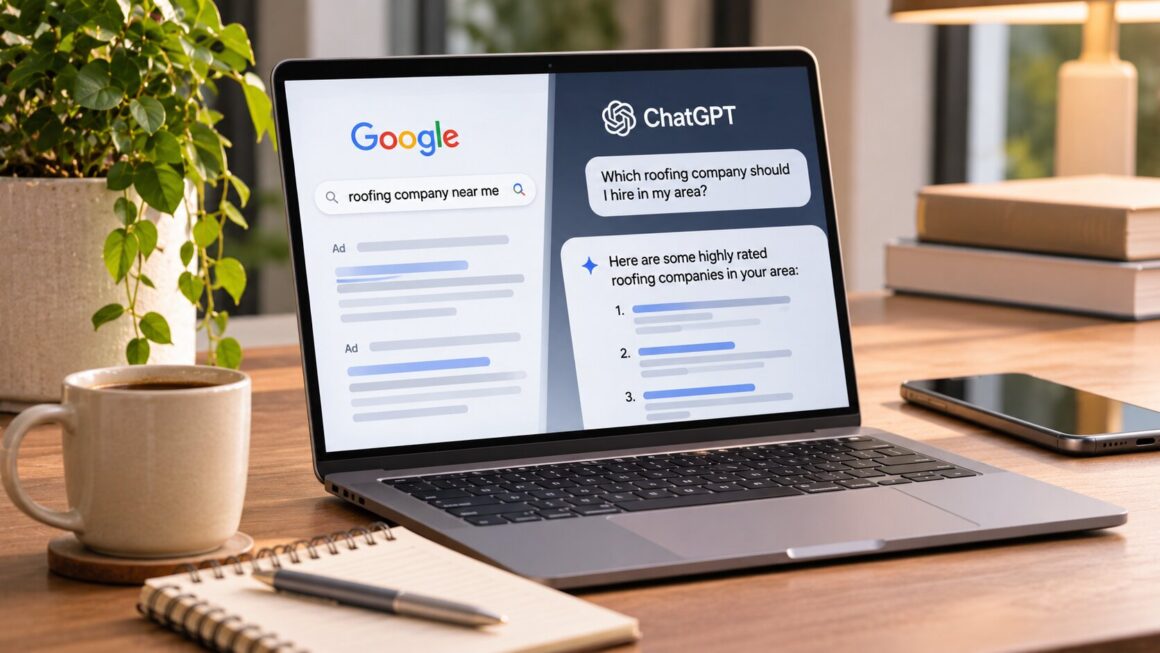
Your site can load fast, pass every Core Web Vitals check and still be missing from the answers ChatGPT gives your customers. Learning how to improve AI search visibility starts with a simple idea: AI assistants can only recommend a business they can find, read and verify. For website owners, much of that work happens on the site itself.
This checklist turns the November 27, 2026 article from AI Authority Map, “Why Traditional SEO and Paid Ads Are Losing Ground to AI Search,” into tasks you can hand to your developer or tackle in your own dashboard.
Quick answer: To improve AI search visibility, make your website easy for AI systems to reach and trust. Build a source of truth page, keep business details consistent, write service pages that answer high-intent questions, confirm OAI-SearchBot is not blocked, and test what ChatGPT, Gemini and Claude say about you on a regular schedule.
Why Website Owners Should Care About AI Search Now
More people now ask an AI assistant instead of scanning search results. AI Authority Map notes that consumers use ChatGPT, Gemini and Claude to research companies, compare services and find businesses before they buy.
That changes what “visible” means. A 2025 Pew Research Center study found that Google users clicked a traditional search result in only 8% of visits when an AI summary appeared, compared with 15% when there was none. Fewer clicks reach your pages, so the content AI tools pull from your site carries more weight.
How Do You Improve AI Search Visibility on Your Website?
Treat it as a site maintenance project with five parts. Each item below maps to an area AI Authority Map says to review.
1. Build a source of truth page
A source of truth page brings your essential company information into one dependable place: what you do, where you operate, your services, credentials and the evidence behind them. AI Authority Map recommends it as a practical starting point because it helps customers and search systems confirm key facts quickly.
On a WordPress site, this can be a standard page linked from your main menu or footer. Keep it public and update it whenever details change.
2. Keep business details identical everywhere
Your company name, locations, contact details and service areas should match across your website, business listings and profiles. Inconsistent details make it harder for any system to confirm who you are. Structured data can help here; our explainer on how WordPress plugins handle schema markup covers the setup side.
3. Check crawler access for AI search
This is the step most site owners skip. According to OpenAI’s guidance for website publishers, allowing OAI-SearchBot to access your site helps make your content discoveratrong reputation alone does not guarantee a mention. Decades of experience or excellent reviews only help if that information is discoverable and verifiable online.
AI Authority Map highlights five factors:
- Consistent business information across names, locations, contact details and service areas.
- Independent references from industry publications, professional organizations and reputable websites.
- Customer reputation built on genuine reviews.
- Original expertise that reflects real experience and answers customer questions.
- Website accessibility, so search systems can discover and interpret public information.
Different AI platforms retrieve and present information in different ways. Visibility on one does not automatically carry over to another.
How Can Businesses Prepare for an AI-First Search Future?
The source article lays out a practical path.
- Audit current visibility. Ask ChatGPT, Gemini and Claude real customer questions and record which businesses and sources appear. Repeat periodically, since a single answer is not a definitive measurement.
- Prioritize high-intent questions. Build service pages that explain what you offer, who you serve, where you operate and what customers can expect.
- Open the door to AI crawlers. OpenAI’s guidance for website publishers says allowing OAI-SearchBot to access your site helps make content discoverable for ChatGPT Search.
- Build a source of truth page. Gather company information, services, credentials and supporting evidence in one reliable place.
- Strengthen reputation. Publish original insights, keep listings accurate, encourage genuine feedback and pursue relevant recognition.
Technical health still underpins all of this, which is why a regular SEO site audit remains worth doing.
Will Website Traffic Still Matter?
It matters, but it tells less of the story. AI Authority Map recommends tracking qualified inquiries, conversion rates, customer acquisition costs and AI search mentions alongside traffic. Those measures show which channels contribute to real business growth when fewer people click through.
Key Takeaways
- Traditional search returns links to compare; AI search returns direct answers that may name only a few businesses.
- Pew Research Center found Google clicks on traditional results fell from 15% to 8% of visits when an AI summary appeared.
- Google says established SEO practices still matter for its AI-powered search features.
- AEO extends SEO and paid ads rather than replacing them.
- Measure qualified inquiries and AI mentions, not just traffic.
Frequently Asked Questions
What is the main difference between AI search and traditional search?
Traditional search shows a ranked list of links that users compare and click. AI search, through assistants like ChatGPT, Gemini and Claude, writes a direct answer that may recommend specific businesses. Users can get what they need without visiting a website, which changes how visibility is earned and measured.
Is AI search reducing website clicks?
Evidence suggests it can. A 2025 Pew Research Center study found that Google users clicked a traditional search result in 8% of visits when an AI summary appeared, compared with 15% when none appeared. That helps explain why steady rankings may no longer deliver the same traffic.
Will AI search replace SEO?
Not according to current guidance. Google says established SEO practices remain important for appearing in its AI-powered search experiences. AI Authority Map describes Answer Engine Optimization as an extension of SEO and paid advertising, so businesses should keep both while adding AI visibility checks.
How can a business tell if it appears in AI search?
Ask ChatGPT, Gemini and Claude questions your customers would ask, then note which businesses are named, which sources are cited and whether yours appears. Repeat the checks over time, because AI answers vary by platform, location, wording and the information available.
To explore how your business appears in AI-generated recommendations, visit AI Authority Map.